Who can witness and sign a will?
Witnessing a will might sound straightforward, but in order for it to be legally binding, you’ll need to follow the correct procedures. So to give you peace of mind, we’ve put together a guide to explain who can sign and witness a will.

You may also be interested in..
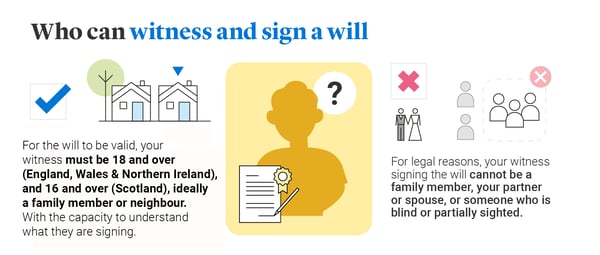
In order for the will to be valid, your witness must:
Specific requirements based on location
An executor can witness a will in the UK, but only if they are not also a beneficiary (or the spouse/civil partner of a beneficiary). It's generally advised to have independent witnesses, meaning individuals who are not named in the will or related to those who are.
Yes, the person making the will can instruct someone else, such as a solicitor, to sign a will on their behalf. Once the document is signed, the will itself does not need to be approved or registered by a solicitor.
You might be able to store your will in a solicitor's office if you'd rather not keep it at home.
Yes, a stranger can be a witness to a will, but this is normally inadvisable. This is because the witness could in theory be called upon to testify that the will was executed correctly. Ideally, the witness should be easy to locate and a reliable person.
If a witness or witnesses to a will pass away, the will remains valid. However, it's possible that during the probate process, the executor would be required to submit proof that the signature is valid. For this reason, if a witness had died, some people choose to write a new will or amend their existing one, known as a codicil.
If a will isn't properly witnessed, it could be declared invalid by a court. This would mean that an earlier will would be considered the valid document, or if there is no previous will, the rules of intestacy would apply.
In theory, anyone can contest a will, and a court would ultimately rule whether there was valid grounds for challenging the will.
Witnessing a will isn’t simply a legal obligation. For a will to be valid it must be signed by the testator and their signature must be made or acknowledged in the presence of two witnesses. The witness must be present at the same time and must also attest and sign the will.
In Scotland, a will needs to be signed by the granter (the individual creating the will) at the bottom of each page. The granters signature should also be witnessed by one independent adult witness. Which in this case means anyone over the age of 16 can witness a signature.
Virtual will witnessing
Virtual witnesses were temporarily accepted during Covid-19 pandemic, when the Wills Act 1837 was amended so that witnessing a will using video-conferencing technology became lawful. However, it was only possible to witness a will virtually until 31st January 2024, as the Law Commission have concluded that the new arrangements will need to be made so that electronic wills can meet the same formal standards as paper wills.
As it stands, the law on witnessing a will virtually also applies to codicils, which follow the same criteria as when writing a will, such as having two independent witnesses.

Find out more about our life insurance

More articles and guides

Over 50 Life Insurance

The importance of writing a will

Contesting a will

What are the duties of the executor of a will?

Conditional gifts in a will