
The benefits of adding more to your stocks and shares ISA
We recently discussed what compound growth is, and why it matters. Now we’re going to look at how to invest to make the most of it.

When it comes to investing, you’re probably expecting to read about what fund you should buy and why. Of course, fund choice does matter when it comes to achieving your future financial goals. But there are two other factors in investing that matter far more.
They are:
- how much you decide to invest
- how long you invest for
It makes sense that the more you add to your stocks and shares ISA, the more money you’re likely to build up over time. In fact, the two are directly proportional. It’s also logical that the longer you hold your investments for could further improve long-term financial outcomes, since you’ll be giving your money more time to grow.
How compounding works over time
Thanks to compounding, your ISA savings have the power to grow even more over time. A 7% annual return is much more valuable after many years of investing than it is at the start because it’s applied to a larger pot of money.
Let’s look at a quick example of compounding:
- If Faith invested £10,000 in her ISA and it grew by 7% in the first year, her ISA value would be £10,700. That’s an annual increase of £700.
- If she left her £10,000 invested for 10 years and enjoyed the same 7% annual return, her money could grow by more and more each year because it would be applied to a larger amount.
- So by her 10th anniversary of investing, her initial investment of £10,000 could be closer to £20,000.
Of course, these numbers are just an illustration. The value of an investment isn’t guaranteed and will go down as well as up, and you may get back less than the original amount you invested. We also haven’t included any fees and charges which may apply to your ISA investments. You can learn more about how compounding works in our article on compound growth.
Maximising your allowance over the long term
Now let’s consider what could happen if Faith combined these powerful factors: adding to her ISA consistently, and giving it lots of time to grow. Using the same average return of 7%, and assuming she was able to invest her full ISA allowance of £20,000 at the start of each tax year, how much could that potentially be worth – free from UK income and capital gains tax – at the end of a 25-year period?
The answer might surprise you - it’s over £1.3 million. So if you currently invest in a stocks and shares ISA, it might be time to give it a boost and tap into the power of compounding.
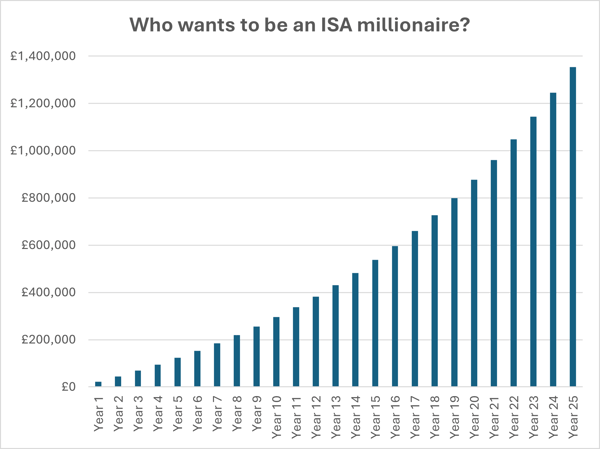
Note: This graph is for illustrative purposes only and based on adding your full ISA allowance of £20,000 each tax year for 25 years with an average return of 7%. It doesn’t take into account any fees or charges you may have to pay on your investments. This return isn’t guaranteed, and you may get back less than you invest. Tax rules may change in the future and are based on your individual circumstances.
Here are some tips to help you grow your ISA
Invest for the long term
You can only enjoy the benefits of compounding if you trust the process. While it might be tempting to react to market volatility, compounding only works if your money stays invested.
Top up when you can
Whether that’s a lump sum when you have some spare money or increasing your direct debit when you’ve had a pay rise, building up regular or one-off payments can have a big impact on the long-term growth of your ISA.
Use up your annual allowance
Each tax year your £20,000 annual tax-free allowance re-sets and can’t be carried over. Maximising your allowance as early as possible gives it more time to grow, making the most of that compounding we mentioned earlier.
Review your funds
Are they performing well, do you feel like you want to move your investments into other funds that could be performing better? Perhaps you want to change your level of risk?
Transfer your ISAs
Do you have a few ISAs in different places? Would life be simpler if you had them all in one place? How much are the fees that you’re paying? Is the app easy to use? It could be time to transfer your ISAs into one, giving you a larger pot to grow. That growth isn't guaranteed though, you could get back less than you put in, and it's important to carefully follow the transfer process to retain the tax benefits.

Related articles

What is compound interest?

What is core and satellite investing?