Is life insurance worth it?
Life insurance can be worth it if other people rely on you financially or for unpaid care, such as looking after children or relatives. If you were to die, the payout from a valid life insurance claim could provide a financial support for your family, helping with costs such as the mortgage, household bills, childcare or care for relatives.
In this article, we’ll take a look at when life insurance could be worth it, who might benefit from cover and what could happen financially if someone dies without life insurance.

You may also like...
Life insurance pays a cash sum if you die while covered by the policy. Terminal Illness Cover is also included with L&G Life Insurance and Decreasing Life Insurance, and Critical Illness Cover can be added for an extra cost when you apply.
When you take out life insurance, you choose how much cover you need and how long you want it to last. Think about the financial commitments you want to help protect, such as your mortgage, rent or your family's ongoing living costs.
You'll pay regular premiums to keep your policy in place. If you don't pay your premiums when they're due, your insurer may cancel your policy.
Life Insurance - uncovered
Life insurance can provide welcome financial protection for your loved ones, but what is life insurance and how does it work? Our expert Barry explains all.

When is life insurance worth it?
If you reach a stage of life when others rely on you financially or for unpaid care, life insurance can be worth it. This could include:

Buying a property
Life insurance could help your loved ones repay an outstanding mortgage if you die while covered. If you rent, a payout could also help your loved ones manage ongoing housing costs.

Getting married
Life insurance can help protect your spouse financially if you were to pass away.

Moving in with a partner
If you’re unmarried but in a long-term relationship, you could name your partner as a life insurance beneficiary.

Having children
Life insurance could help protect your children financially if you were no longer around to provide for them, helping towards ongoing costs such as nursery fees, hobbies or education.
Caring for others
If people rely on you for unpaid care or support, such as housework or looking after older relatives, life insurance could help towards the cost of replacing some of the things you currently do.

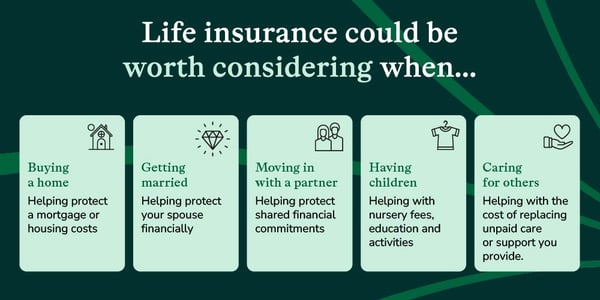
You may feel you can manage without life insurance if the following applies to you:
- Your children are financially independent. If your adult children have ‘flown the nest’, you may have less need for any life insurance payout.
- You have no financial dependants. For example, some single adults may not require life insurance.
- You have significant savings. Could your loved ones manage despite the financial impact of your death?
- You’re covered through work. Some people have death in service benefit through their employer; however, these policies usually end when you leave an organisation.
- You may not be able to afford the premiums. While L&G Life Insurance is available from just £5 a month, you may decide that cover isn’t appropriate if you’re unable to keep up with the premiums.
Life Insurance is for family and/or mortgage protection. The amount of cover and premiums stay the same, unless you make any changes. It can help protect your family's everyday living expenses, help pay off a mortgage or both.
Decreasing Life Insurance protects a repayment mortgage. The cover amount reduces over time, roughly in line with the way a repayment mortgage decreases. Your premiums stay the same. Because cover goes down, it's often cheaper than Life Insurance.
Critical Illness Cover can be added for an extra cost when taking out one of our life insurance policies. It covers you if you're diagnosed with, or undergo a medical procedure for one of our specified critical illnesses. You need to survive for 14 days from diagnosis. The critical illnesses we cover can be life changing. In the event of a valid claim it could be used to give financial support for recovery time, treatment or adapting to a new normal.
- You won’t be covered if you pass away due to suicide or intentional and serious self-injury within the first year of taking out a policy.
- Your premiums will need to be paid – and up to date – in order for a valid claim to be made.
- For Terminal Illness Cover claims, you would need to be diagnosed with a terminal illness where the life expectancy is less than 12 months.
We may not pay your chosen cash sum if you don't give honest answers when you apply for a policy. See a full list of what is and isn't covered in our Policy Terms and Conditions document before you apply.
If you’re over 18 and other people depend on you financially, life insurance could be right for you. For example, if you’re a homeowner, a parent or responsible for anyone else’s financial security, life insurance is something you may wish to think about. If you pass away during the policy term, your loved ones could receive a cash sum, which can be used to meet their ongoing living costs.
Life insurance for partners
It’s worth remembering that life insurance isn’t just for married couples, but long-term cohabiting couples too – sometimes known as common law marriage.
If you have a partner or spouse, you can decide whether to get single or joint life insurance. The latter pays out upon the death of the first insured person, at which point the policy ends. However, you can have two single policies as a couple, which means that even after the first death, the surviving partner still has their own policy.
Life insurance isn’t just for high earners. It can be worth considering for a range of households, including those on lower incomes. Consider the following:
- Life insurance is available from as little as £5 a month, depending on your protection needs.
- Life insurance is usually more affordable when you’re younger.
- A joint life insurance policy will normally cost less than two separate single life insurance policies.
If you’re not the ‘breadwinner’, life insurance can still be worth considering. Looking after children, caring for relatives or taking on other unpaid work takes time and could have a financial impact if you were no longer around. Ask yourself:
- Could your family manage if you were no longer around?
- Would your partner have to take time off work to look after the children?
- Would other relatives get the support they need?
A life insurance payout could help with some of these costs, for example by contributing towards the mortgage, childcare or other everyday living expenses.
If you die without life insurance, there won’t be a life insurance payout to help your loved ones financially. Depending on your circumstances and any other arrangements you have in place, your loved ones may need to rely on savings, other assets or financial support to help manage ongoing costs.
If other people rely on your income or unpaid care, you may therefore want to consider whether life insurance, savings or other financial arrangements could help meet their needs if you die.
You can decide who you’d like to benefit from your life insurance. You may be able to make provisions in your Will or place your life insurance policy in Trust. We offer our customers an easy to use Trust service.
Putting life insurance in Trust can help make sure the payout goes to the people you choose. Find out more in our useful guide.
Why life insurance matters - your checklist
If you have a life insurance policy in place and you pass away, the payout from a valid claim can help with the following:
- Mortgage. If you have a repayment mortgage, Decreasing Life Insurance could help pay off the remaining mortgage amount if you were to die.
- Rent. If you rent, a life insurance claim could also help your loved ones make the monthly payments to the landlord in the event of your death.
- Household bills. There’s more to housing costs than paying the mortgage or rent. Being covered by life insurance means that in the event of dying, your dependants could still manage the ongoing cost of utilities like gas, electricity and water.
- Childcare costs. If you have young children, a life insurance payout could contribute towards the cost of nursery or a childminder if you were to die. And a life insurance payout can also cover the educational costs associated with older children – from independent school fees to trips, uniforms and tutoring.
- Hobbies and activities. Would your loved ones be able to pursue their hobbies and interests if you were to pass away? Many activities incur costs – from horse riding and football practice to buying musical instruments.
- Everyday living. There is no mandatory list of what someone can or can’t spend a life insurance payout on, and there are many daily living costs – from food to fuel – that a life insurance policy can help protect.
As the above examples suggest, dying without life insurance can lead to financial difficulties for your loved ones. However, that is not to say life insurance is for everyone. You may instead pass on other assets, such as property or savings and investments. Life insurance may also not be for you if you have nobody that relies on you financially.
Our Life Insurance is designed to provide financial protection if you die while covered by the policy. We offer two types of cover:
Life Insurance – Your chosen cash sum could be paid out if you die during the length of the policy. It could be used to help protect the family's lifestyle and everyday living expenses or help to pay the mortgage.
Decreasing Life Insurance – This is designed to help protect a repayment mortgage so the amount of cover reduces roughly in line with the way a repayment mortgage decreases. This could help your loved ones repay some or all of the outstanding repayment mortgage if a valid claim is made.
Please remember that life insurance is not a savings or investment product and has no cash value unless a valid claim is made.
So, is it worth having life insurance? Every household has different needs, but if you want to help provide for your family at a difficult time, life insurance really could be worth it.
Want to learn more?